
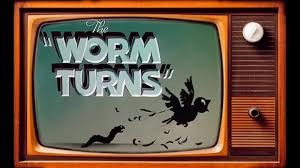
What was said? “Eventually, the worm is going to turn.’”
Did someone really say that? Yes, in a meeting discussing employee survey results and how they eventually will “get better.”
What does it mean? In this instance, it’s more about a change in luck. The outlook shifts from a bleak forecast to a bright one. It can also refer to a person who has been treated badly for some time. Eventually, they resist and stand up to their “attacker.”
More on the Meaning: Before we jump into the origin, there are two camps of what this phrase (usually cited as “the worm turns”) means.
- A shift from bad luck / outcome –> good luck / success
- Even the meekest eventually gets pushed too far and rallies and seeks revenge
Example: It seems the worm has turned and after years of silence, the local people are beginning to protest about factory waste emissions.
Origin: The phrase that correlates to the 2nd meaning above, was first recorded in a 1546 collection of proverbs by John Heywood in “Treade a worme on the tayle, and it must turne agayne.” It was used in William Shakespeare’s play Henry VI, spoken by Lord Clifford:
To whom do lions cast their gentle looks?
Not to the beast that would usurp their den.
The smallest worm will turn being trodden on,And doves will peck in safeguard of their brood.
The phrase (and main image of this post) was an episode title in Mickey Mouse – aired in 1937. The premise is that Mickey Mouse, as a chemist, creates a “Courage Builder” potion that flips the food chain allowing the eaten to turn on the eaters (e.g., a fly turns on a spider, a mouse on a cat).
 HOT Idioms
Give me your two cents...