
What’s the Beef?

What was said? “What’s the Beef?”

Did someone really say that? Yes, Jimmy Fallon has a segment on the Tonight Show called “What’s the Beef?” where he creates fictional fights between famous actors. I was watching with my parents and they were naturally questioning… “why beef?”

What does it mean? It means to have a problem or issue with someone or something, so in the context above, “what’s the issue/argument all about?”

Origin:

There are many ideas as to where this phrase started… all the way from it originating from rap songs signifying that when someone has “beef” with you, it ends up with a street fight where your face could get so banged up that it resembles ground beef, all the way to having to do with cow ownership and “beefy” situations:

  • The phrase “I have a beef with you” originated in the old west among sheep farmers who were competing for grazing land with cattle farmers. The sheep farmers used the term with each other to refer to a conflict, which was what they had with the cattle farmers, or “beef” farmers (answers.com)
  • Having to do with the ownership of cows and “cow feuds” which resulted as owners argued over the best interests of the cow and typically the cow got slaughtered and led to owners having “beef” with one another (10poundhammer blog)
  • First appearing in the U.S. during the late 1800s, “beef” describes a situation or complaint that might well escalate into a “beefy” muscular conflict (Word Detective)

So it seems, that there is not one origin for the phrase, but either way, Jimmy’s segment will make a lot more sense now!

Jimmy Fallon's "What the Beef?" Segment - Click to Play!
Jimmy Fallon’s “What the Beef?” Segment – Click to Play!

REFERRALS:  Do you LOVE Rema’s Idiom Blog and look forward to it all the time? If so, refer your friends!

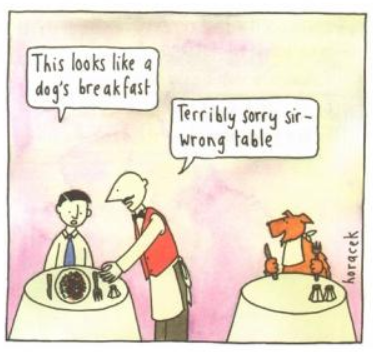
Dog’s Breakfast

Dog Breakfast Pic

Volume 3. Issue 9.

What was said? “The meeting was a complete dog’s breakfast…”

Did someone really say that? Yes, in response to the question “how did the meeting go?” and apparently it was a disaster

What does it mean? It really just translates to a complete mess, mish-mash, hodgepodge or something that has gone very badly where the outcome wasn’t what was intended to be

Origin: Since the 1930’s, the saying “dog’s breakfast” has been used in the U.K. and Commonwealth countries as slang for “a complete mess.”  First recorded instance is from Eric Partridge, in the 1937 edition of his A Dictionary of Slang and Unconventional English, the expression is listed as “a mess.” Although the origin isn’t exactly known, it alludes to the fact that if what you don’t succeed at what you are cooking, then the results are only fit for a dog. It’s usage can be widespread – from what a messy room looks like, to how a meeting went (like the example above).  It is suggested that this dates from a time before canned dog food when a pup’s breakfast would have consisted of dinner leftovers from the night before; hence, “a mess.” Not to be confused with a  parallel expression “a dog’s dinner” which means quite the opposite and usually comes in the form of “all dressed up like a dog’s dinner” and sarcastically means over-dressed / showy.

Sources:

http://www.merriam-webster.com/dictionary/dog’s%20breakfast
http://www.nytimes.com/1993/03/07/magazine/on-language-dog-s-breakfast.html
http://dogknowledge.net/dog-stories-and-facts/dog-funny-stories/a-dogs-breakfast-and-a-dogs-dinner.php
http://idioms.thefreedictionary.com/a+dog’s+breakfast
http://www.urbandictionary.com/define.php?term=dog%27s%20breakfast
http://www.phrases.org.uk/meanings/114550.html

REFERRALS:  Do you LOVE Rema’s Idiom Blog and look forward to it all the time? If so, refer your friends!
You are currently subscribed to: REMA’s “Making Heads or Tails of Idioms” blog! To unsubscribe, follow the instructions. If you unsubscribe, please know that you will be disliked.

Belt and Suspenders

Volume 3. Issue 8.

What was said? That was so “belt and suspenders” of us anyway…

Did someone really say that? Yes, my friend Rita and I were walking to a restaurant in Nashville with both our Google maps app open on our iPhone and a paper printout of the directions. When we realized we lost the printout along our walk, Rita proclaimed the phrase above.

What does it mean? Someone who wears a belt and suspenders is very cautious and takes no risks. It refers to redundant systems, a form of “double insurance,” where either the belt or the suspenders serve as a backup in the event of the other failing (literally – no one needs to wear both a belt and suspenders to hold up their pants!)

Origin: First found in print in 1935 in the Galveston Daily News, where the ‘News Behind the News’ column states: “A pessimist wears both belt and suspenders.” Today, the phrase “belt and suspenders,” is used mainly in business and law when two strategies are used to minimize the risk that would be exist should only one strategy be in place.

Sources:

http://onlinelaw.wustl.edu/legal-english-belt-and-suspenders/
http://www.phrases.org.uk/meanings/61250.html
http://www.usingenglish.com/reference/idioms/belt+and+suspenders.html
http://www.investopedia.com/terms/b/belt-and-suspenders.asp
http://en.wiktionary.org/wiki/belt_and_suspenders
http://www.urbandictionary.com/define.php?term=belt-and-suspenders%20man

REFERRALS:  Do you LOVE Rema’s Idiom Blog and look forward to it all the time? If so, refer your friends!

————————————————————————————————————————–
You are currently subscribed to: REMA’s “Making Heads or Tails of Idioms” blog! To unsubscribe, follow the instructions. If you unsubscribe, please know that you will be disliked.

Johnny on the Spot

Volume 3. Issue 7.

What was said? We need a printer in Chicago… Johnny on the spot. You got it?

Did someone really say that? Yes, when working on a proposal and we needed to make sure we had a print house ready to meet our oddest and slightly unrealistic demands.

What does it mean? A person who is on hand and ready to perform a service or respond to an emergency (Merriam-Webster Dictionary)

Origin: The phrase dates back to 1896 and was the subject of an article in the New York Sun titled “Johnny on the Spot: A New Phrase Which Has Become Popular in New York.” The article details the expression that had become very popular in NYC. According to the writer, the phrase is from a slightly longer version, ‘Johnny is always on the spot when wanted.’ … where Johnny refers to a general male (like John Doe). Although, the author does venture to provide a little more detail on who Johnny is: “a man or youth who may be relied upon to be at a certain stated place when wanted… an individual who is prompt and farseeing, alive to his own interests and keenly sensible of means for promoting his own advantage is a ‘Johnny on the spot.’”

The original article was syndicated and below is the reprint found in the San Francisco Call from April 1896

Side Note:  There are few companies appropriately named “Johnny on the Spot” in the US. They are suppliers of portable restrooms / bathrooms and are on-hand and ready to preform a service / respond to an emergency!

Portable Toilet
Talk about a Johnny on the Spot!

Sources:
http://www.merriam-webster.com/dictionary/johnny-on-the-spot
http://www.worldwidewords.org/qa/qa-joh3.htm
http://wiki.answers.com/Q/What_is_the_etymology_of_Johnny_on_the_spot

REFERRALS:  Do you LOVE Rema’s Idiom Blog and look forward to it all the time? If so, refer your friends!

————————————————————————————————————————–
You are currently subscribed to: REMA’s “Making Heads or Tails of Idioms” blog! To unsubscribe, follow the instructions. If you unsubscribe, please know that you will be disliked.

Blue Bird Opportunity

Volume 3. Issue 6.

What was said? “If they are all the right ‘blue birds,’ then no action is required”

Did someone really say that? Yes, in an email referencing a list of potential project / sales opportunities.

What does it mean? An easily made sales opportunity that is unexpected or very profitable.

Origin: Bluebird is defined as ‘happiness’ by the Oxford English Dictionary with its origin dating back to 1909. Most of us know the bluebird (also blue-bird and blue bird) as an actual bird found commonly in North America. The first mention of bluebird was in the “l’Oiseau bleu” 1909 play by Belgian dramatist and poet Maurice Maeterlinck, literally translating to “The Blue Bird” with the figurative speech used in the play “the bluebird of happiness.” Bluebirds tend to elicit happiness as seen in the song “ Somewhere over the rainbow, bluebirds fly” from the Wizard of Oz from 1939. The term has been increasingly used in corporate circles in the past few years and “Bluebirds are those new business opportunities, which seem to fly in through the window. Many professional services firms are tempted to pitch for every bluebird that comes their way, but this may not be a profitable use of their resources in the long-term (How to Manage Bluebirds). In a nutshell it’s sales slang for an opportunity (or actual sale) that presents itself to the salesperson or the selling organization without having made much direct effort in securing it.

[image: slideshow]

Side Note: Most school buses in the US are made by the Blue Bird Corporation, which began in 1927 and is based in Fort Valley, GA.

Sources:
http://salesdictionary.com/index.php?term=b&tab=%3F
http://onlineslangdictionary.com/meaning-definition-of/bluebird
http://www.waywordradio.org/bluebird/
http://www.etymonline.com/index.php?search=hermann+maurice+saxe
http://businesstoday.intoday.in/story/new-words-in-business/1/13969.html
http://www.infobarrel.com/The_Blue_Bird_of_Happiness_Phrase:_Origins_and_Meanings

REFERRALS:  Do you LOVE Rema’s Idiom Blog and look forward to it all the time? If so, refer your friends!

————————————————————————————————————————–
You are currently subscribed to: REMA’s “Making Heads or Tails of Idioms” blog! To unsubscribe, follow the instructions. If you unsubscribe, please know that you will be disliked.

Kit and Kaboodle

Volume 3. Issue 5.

What was said? “So… I mean the whole kit and kaboodle on the job front is…”

Did someone really say that? Yes, in an email to me about what’s really going on with a friend’s job.

What does it mean? The whole shebang, the works, the full story.

Origin: “Kit and Kaboodle” has origins in the 18th century, England. Kit, which comes from the word “kith” meaning “estate.” So the “Whole Kith” would mean everything one owns. Soldiers in the 1700’s also carried a bag with everything they needed called a Kitbag. Kaboodle (or Caboodle) has a few more variations of origin. Some say it comes from “boodle” which was known to describe a collection of items or people. Caboodle was also used at times as a legal term for “estate”.  Some believe it’s from the Dutch boedel, meaning one’s inheritance or estate. In the US, boodle came to mean money attained illegally / through corrupt means. The phrase “the whole boodle” can also be used to describe the same thing. The phrase also appears in Grose’s Dictionary of the Vulgar Tongue in 1785, a dictionary of slang words, pretty much the precursor to Urban Dictionary.

Commercially, Purina’s “Kit and Kaboodle” pet food means your precious little cat is getting “the works”.

In the 90’s, there was an extremely popular product: the “Caboodle”… it was a magical place for teenage girls to store the makeup they weren’t allowed to wear.

Sources:
http://www.worldwidewords.org/qa/qa-who2.htm
http://www.phrases.org.uk/bulletin_board/2/messages/329.html
http://ahoy.tk-jk.net/macslog/MurrayWaldrenscolumnThats.html

REFERRALS:  Do you LOVE Rema’s Idiom Blog and look forward to it all the time? If so, refer your friends!

—————————————————————————————————————————————————–
You are currently subscribed to: REMA’s “Making Heads or Tails of Idioms” blog! To unsubscribe, follow the instructions. If you unsubscribe, please know that you will be disliked.

Month of Sundays

Volume 3. Issue 4.

What was said?  It will take you a month of Sundays to get through all the revisions.

Did someone really say that? Yes, in a client meeting discussing product promotions at retailers and the many revisions that are made before the promotion goes live.

What does it mean? Something that is going to take a LONG TIME…. A seemingly endless or prolonged period of time.

Origin: The expression is said to mean 30/31 weeks (the amount of time it takes a month of Sundays to pass) and has is believed to have origins from the Christian Holy Day of Sunday, the Sabbath. This day was a “day of rest” and was a long, solemn day devoid of amusement. Activities were even regulated on Sunday by law at times and therefore Sunday could seem long and tiresome (out of boredom)… therefore a month of Sundays could feel like an eternity. It is also sometimes used to denote something that will never happen.

The Oxford English Dictionary cites the first printed use of the phrase from 1759:

“The commander..swore he should dance to the second part of the same tune, for a month of Sundays.”
H. MURRAY Life & Real Adventures Hamilton Murray I. x. 121

NOTE: There are some variations on this, such as: Week of Sundays, Week of Saturdays, etc.

A whole month of Sundays

Sources:

http://dictionary.reference.com/browse/month+of+sundays,+a

http://www.phrases.org.uk/bulletin_board/59/messages/129.html

http://www.wordwizard.com/phpbb3/viewtopic.php?t=20154

http://www.wisegeek.com/what-does-the-idiom-a-month-of-sundays-mean.htm#did-you-know

REFERRALS:  Do you LOVE Rema’s Idiom Blog and look forward to it all the time? If so, refer your friends!

—————————————————————————————————————————————————–
You are currently subscribed to: REMA’s “Making Heads or Tails of Idioms” blog! To unsubscribe, follow the instructions. If you unsubscribe, please know that you will be disliked.

Six Ways To/From Sunday

Volume 3. Issue 3.

What was said?  We can go about it 6 ways from Sunday, but we need to just pick an approach and go with it.

Did someone really say that? Yes, in a meeting a few months ago when we needed to just get started on the work and we were belaboring how we were going to do it.

Another example from Urban Dictionary: “There are six ways from Sunday to calculate that physics problem but only one answer.”

What does it mean? To do something thoroughly, completely and in every way imaginable.

Origin: Unfortunately there is no clear origin to this expression, and at times it is said to Sunday, from Sunday and the number can range from 2 ways to 100 ways and so on (in the movie “Silver Lining Playbook” Bradley Cooper uses “10 ways to Sunday”)… There are even tales of “beating people who didn’t go to church on time six ways to Sunday” but none of them seem to hold any water.

What we do know is that on the calendar, there are six days after Sunday, and six days before Sunday. The phrase points out the inevitability of arriving to Sunday, no matter what day is the starting point. Implying there are six different ways to Sunday illustrates that any task/problem  has more than one way to approach it. To discuss a topic and use this idiom means that there are multiple options to follow to arrive at the same conclusion.

Whatever the number or preposition used, the expression “__ ways to/from Sunday” means “every possible way” or “all the ways I can think of.”

“Six Ways to Sunday” is also a title of a 1997 mob-related movie staring Deborah Harry.

Sources:

http://www.wisegeek.com/what-does-the-idiom-six-ways-to-sunday-mean.htm

http://www.urbandictionary.com/define.php?term=six%20ways%20from%20sunday

REFERRALS:  Do you LOVE Rema’s Idiom Blog and look forward to it all the time? If so, refer your friends!

—————————————————————————————————————————————————–
You are currently subscribed to: REMA’s “Making Heads or Tails of Idioms” blog! To unsubscribe, follow the instructions. If you unsubscribe, please know that you will be disliked.


Upset the Apple Cart / Applecart

Volume 3. Issue 2. 

What was said? We don’t want to upset the apple cart by changing the time of our workshop…

Did someone really say that? Yesa team member said it in a meeting… then it was repeated two more times that very day!

What does it mean? It means to cause trouble, upset things or create difficulty… especially by spoiling someone’s plans.

Origin:  There are a roughly four variations of the origin of this phrase….

1. This phrase is first recorded by Jeremy Belknap in The History of New Hampshire, 1788: “Adams had almost overset the apple-cart by intruding an amendment of his own fabrication on the morning of the day of ratification” [of the Constitution].

2. According to another source, the original intent was to throw a man down. In the early to late 1800s “apple cart” was wrestlers’ slang for the body and “down with his apple cart” was to throw a man down.

3. Alternatively, some say the concept originated with the Romans who had a similar expression “Perii, plaustrum perculi” – “I am undone, I have upset my cart.”

4. Most basic / generic understanding: It generally refers to farmers in the  1800s would bring applecarts loaded with neatly piled, fresh apples for sale. Along comes a clumsy person who knocks over the cart, spilling all the apples.The farmer’s plan to sell the apples is in turn, “spoiled”.

Sources:

http://idioms.thefreedictionary.com/upset+the+applecart

http://www.phrases.org.uk/meanings/118400.html

http://www.urbandictionary.com/define.php?term=Upset%20The%20Applecart

http://wiki.answers.com/Q/What_is_the_meaning_of_the_idiom_’upset_the_apple_cart’

http://wiki.answers.com/Q/What_is_the_origin_of_the_idiom_’Upset_the_Applecart’

http://englishfromfriends.com/blog/2010/06/23/upset-the-applecart/ 

REFERRALS:  Do you LOVE Rema’s Idiom Blog and look forward to it all the time? If so, refer your friends!

—————————————————————————————————————————
You are currently subscribed to: REMA’s “Making Heads or Tails of Idioms” blog! To unsubscribe, follow the instructions. If you unsubscribe, please know that you will be disliked.

Eat Crow

Volume 3. Issue 1. 

It’s been a while since my last post, so I decided to move on to volume 3. 

What was said? They are going to eat crow when they begin to realize their gaps…

Did someone really say that? Yesa team member said it about a company who was far behind industry standards

What does it mean? It means you are proven wrong, typically through humiliation.

Origin:  The expression has to do with being proved incorrect, like “eat dirt”, “eat your hat/shoe” … all originating from “eat one’s words” which appears in print starting in 1571 in one of John Calvin’s tracts, on Psalm 62: “God eateth not his words when he hath once spoken.” Eating a “crow” is thought of as distasteful and the crow is seen as unfit for eating in the Bible, Leviticus Chapter 11.

To “eat crow” also has to do with humbling oneself to admit to being wrong (equivalent to a British expression “to eat humble pie”). The original phrase is believed to be “to eat boiled crow”, but either way, using the term “eat crow” to mean to be proven wrong, is thought to have first appeared in or around 1850. A story was published in the Saturday Evening Post called “Can you eat crow?” about a NY farmer whose boarders complained about being fed poorly and he responded saying he “kin eat anything” and the boarders tested him by asking if he would eat crow, to which he accepted the challenge but spiked it with Scotch and said “I kin eat crow, but i be darned if I hanker after it.”

Sources:

http://en.wikipedia.org/wiki/Eating_crow
http://www.worldwidewords.org/articles/eatcrow.htm
http://linguisticmystic.com/2006/12/29/eating-crow-an-english-idiom-and-an-example-of-its-use-in-my-personal-life/

REFERRALS:  Do you LOVE Rema’s Idiom Blog and look forward to it all the time? If so, refer your friends!

—————————————————————————————————————————————————–
You are currently subscribed to: REMA’s “Making Heads or Tails of Idioms” blog! To unsubscribe, follow the instructions. If you unsubscribe, please know that you will be disliked.

Website Powered by WordPress.com.

Up ↑